
Wellness: Body & Mind
True wellness for your dog goes beyond just a daily walk. It is a combination of mental comfort—ensuring they feel safe during grooming or vet visits—and proactive physical care to keep their bodies thriving as they age. In this section, we cover both: the behavioral handling techniques that build confidence, and the holistic Traditional Chinese Veterinary Medicine (TCVM) therapies we use to keep The Crew feeling their best.
Handling & Desensitization
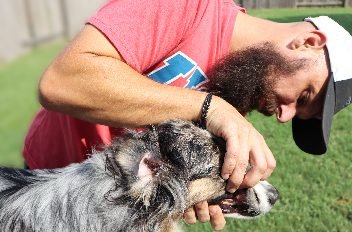
Throughout their life, your dog will have to go to the vet. Teaching your dog to be handled at home will make these visits—and regular grooming—significantly less stressful. If your dog is used to being touched, having their paws handled, or being set on their side, any future medical or grooming experience will be a breeze.
We also want to protect our dogs from daily environmental stress. We all know the frantic barking at the doorbell, hiding from thunder, or lunging at a lawnmower. Desensitizing your dog to these triggers improves their impulse control and makes their daily life (and yours) much more peaceful.





Traditional Chinese Veterinary Medicine (TCVM)
When Leo was diagnosed with arthritis in his wrist, he didn’t seem to get truly comfortable just relying on anti-inflammatory drugs like Carprofen. I started searching for a more holistic approach and was introduced to Dr. Donna Hein, a veterinarian specializing in TCVM.
Instead of just treating the symptom, TCVM looks at the whole dog—including their specific “Element” (Fire, Wood, Earth, Metal, or Water) and how their body processes energy. This opened up a whole new world of physiotherapy, acupuncture, and food therapy that drastically improved Leo’s quality of life.
In holistic medicine, Leo is an Earth element. Earth dogs are incredibly sweet and loyal, but their systems are highly prone to something called Dampness. Think of Dampness exactly like it sounds—a heavy, sluggish buildup that settles right into the joints and causes that painful stiffness. Once we understood this, we stopped just masking the pain and started using specific, food therapy to actually ‘dry out’ and clear that dampness from his system. When you have four dogs with completely different personalities and elements (like our Earth dog Leo and Water dog Chester!), cooking for them sounds impossible.
Here is the secret from the trenches: We don’t cook four different meals.
We cook one large batch of cool and neutral proteins—like lean turkey and lean pork—that works safely for the whole pack. Then, we customize! Because Leo struggles with stiffness (Dampness) and Chester needs similar support, we simply add ingredients like celery and barley directly to their bowls. In holistic food therapy, these ingredients act like natural sponges to gently dry and drain that dampness right out of their joints. On top of that we use some Chinese herbs (Sang Zhi San) when Leo experiences a flare up, but 90% of the time the celery and barley do the trick. In the video down below Leo was so stiff that we used the Chinese herbs daily for about a month.
Food Energy & Elements
In TCVM, food is not just about calories—it’s about energetic properties. Every ingredient is categorized as Warming, Neutral, or Cooling. For example, Leo is an “Earth” dog, which means he runs “Hot” and is prone to inflammation. Dr. Hein had us replace warming proteins like chicken with cooling proteins like turkey and white fish to balance his system.
Knowing your dog’s specific element is the key to customizing their holistic care. (Our free Be A Better Pup app actually calculates this for you automatically!)
TCVM 5-Element Engine Cheat Sheet
Why "Healthy" Superfoods Backfire & What to Feed Instead1. EARTH (Spleen / Stomach — e.g., Leo)
2. WOOD (Liver / Gallbladder — e.g., Dory's Wood side)
3. FIRE (Heart / Small Intestine — e.g., Pumpkin)
4. WATER (Kidney / Bladder — e.g., Chester's Water side)
❄️ BONUS: UNIVERSAL ENGINE KILLER (All 5 Elements)
Understanding Canine Acupressure & The Meridian System
To fully grasp how TCVM game-changers like acupressure work, it is essential to understand how energy moves through your dog’s body. The practice relies on the 12 Major Meridians, which form one continuous channel where chi and nourishing fluids, like blood, flow.
Functions of the Meridian System
-
Energy Pathways: Meridians are relatively superficial channels that flow seamlessly between the skin and muscle tissue.
-
System-Wide Circulation: The meridian system is actively responsible for connecting the entire body and circulating chi, blood, and other vital substances.
-
Internal Connections: Each individual meridian is connected to a specific internal zang-fu organ. This pathway communicates the energy of that specific organ directly to the surface of the dog’s body.
-
Energy Shifts: Meridian energy naturally shifts from yin to yang, and from yang to yin, at the Jing-Well points located on the dog’s paw.
-
The Goal of Acupressure: When you perform an acupressure session, you are not just rubbing skin; you are accessing the energy of the internal organs by “working” with the meridians on the surface of the dog’s body. This facilitates direct communication between the zang-fu organs.
Assessing Your Dog: The Four Pillars
Traditional Chinese Medicine utilizes hundreds of methods to distinguish specific patterns of disharmony. Because internal issues have likely become complicated by the time a dog exhibits physical signs of illness, assessing the root condition requires a comprehensive approach.
Ancient practitioners honed their five senses to assess animal conditions using a framework known as “The Four Pillars” or The Four Examinations (si zhen). This assessment relies on a keen awareness of visible, auditory, olfactory, and touch indicators:
-
Observation: Visually assessing the dog’s posture, movement, and physical features.
-
Listening and Smelling: Tuning into breathing patterns, vocalizations, and any distinct odors.
-
Questions / Inquiry: Gathering behavioral history and noticing environmental changes.
-
Physical Palpation: Using touch to feel for temperature changes, tension, or reactive points along the meridians.
Ready to get hands-on?
Now that you understand the science behind the meridian system, it is time to put it into practice. Create a free account to access our interactive Acupressure Guide, where you will unlock the step-by-step methodology, exact point locators, and session trackers to help your dog heal.